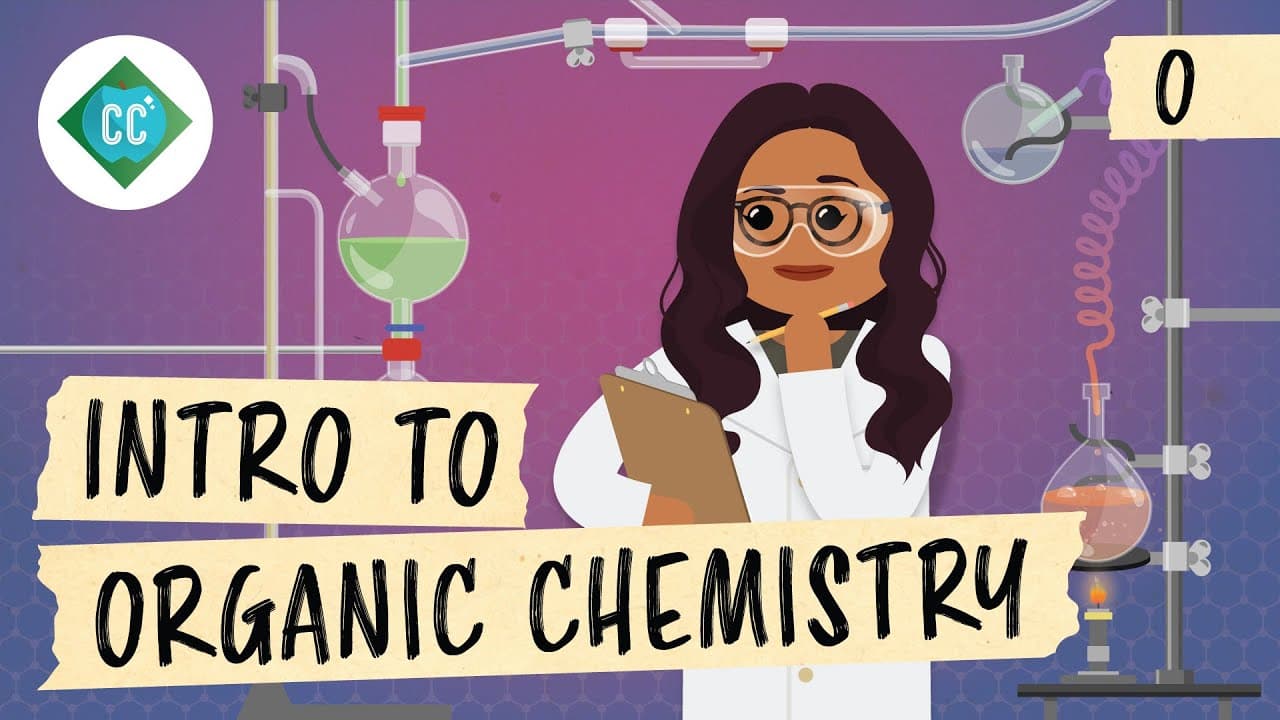

In 50 episodes, Dr. Deboki Chakravarti will teach you organic chemistry. This course is based on sophomore-level college material, covering topics from Organic Chemistry I and II. It was developed with 9 reference texts and journal articles on specialized topics in organic chemistry, in particular: Organic Chemistry texts by Brown, Foote, Iverson and Ansyln (8th ed.); Clayden, Greeves and Warren (2nd ed.); McMurry (9th ed.) By the end of this course, you will be able to: * Recognize and name the major functional groups in organic compounds * Understand the influence of molecular structure and conformation on chemical properties and reactivity * Identify the possible reactions for a given organic compound and select reasonable reaction mechanisms given the reactant structure and functional groups * Sketch a mechanism for an organic reaction, showing valid arrow-pushing and formal charges * Develop and compare synthetic routes to a target molecule from a starting compound * Interpret spectra (e.g. IR, NMR, MS, UV/vis) and understand how they are used in structure determination * Connect the chemical properties of organic compounds to their real-world applications (e.g. in polymers, medicine, and biochemistry).
Season 1
50 Episodes

Tlalane Mohasoa
May 13, 2026These days, we don't have to worry too much about meeting an early demise from ulcers, breaks in the stomach lining that could be fatal back in the early 1900s. This is because we have medicines to treat them, like proton pump inhibitors! In this final episode of Crash Course Organic Chemistry, we'll look at medicinal chemistry by breaking down how penicillin fights bacteria, how proteins are made both in the body and in the lab, and we'll finally finish our synthesis of penicillin V and complete our Mold Medicine Map! Hopefully this series has shown you the many ways organic chemistry is all around us and how it can help us to better understand ourselves, and improve our world! Episode Sources: Patrick, G. L. (2013). An introduction to medicinal chemistry. Oxford university press. Vollmer, W., Blanot, D., & De Pedro, M. A. (2008). Peptidoglycan structure and architecture. FEMS microbiology reviews, 32(2), 149-167. Sauvage, E., Duez, C., Herman, R., Kerff, F., Petrella, S., Anderson,

Messie Obami
May 13, 2026These days, we don't have to worry too much about meeting an early demise from ulcers, breaks in the stomach lining that could be fatal back in the early 1900s. This is because we have medicines to treat them, like proton pump inhibitors! In this final episode of Crash Course Organic Chemistry, we'll look at medicinal chemistry by breaking down how penicillin fights bacteria, how proteins are made both in the body and in the lab, and we'll finally finish our synthesis of penicillin V and complete our Mold Medicine Map! Hopefully this series has shown you the many ways organic chemistry is all around us and how it can help us to better understand ourselves, and improve our world! Episode Sources: Patrick, G. L. (2013). An introduction to medicinal chemistry. Oxford university press. Vollmer, W., Blanot, D., & De Pedro, M. A. (2008). Peptidoglycan structure and architecture. FEMS microbiology reviews, 32(2), 149-167. Sauvage, E., Duez, C., Herman, R., Kerff, F., Petrella, S., Anderson,
Olivia Jesaya
May 13, 2026These days, we don't have to worry too much about meeting an early demise from ulcers, breaks in the stomach lining that could be fatal back in the early 1900s. This is because we have medicines to treat them, like proton pump inhibitors! In this final episode of Crash Course Organic Chemistry, we'll look at medicinal chemistry by breaking down how penicillin fights bacteria, how proteins are made both in the body and in the lab, and we'll finally finish our synthesis of penicillin V and complete our Mold Medicine Map! Hopefully this series has shown you the many ways organic chemistry is all around us and how it can help us to better understand ourselves, and improve our world! Episode Sources: Patrick, G. L. (2013). An introduction to medicinal chemistry. Oxford university press. Vollmer, W., Blanot, D., & De Pedro, M. A. (2008). Peptidoglycan structure and architecture. FEMS microbiology reviews, 32(2), 149-167. Sauvage, E., Duez, C., Herman, R., Kerff, F., Petrella, S., Anderson,

Tdk Macassette
May 13, 2026These days, we don't have to worry too much about meeting an early demise from ulcers, breaks in the stomach lining that could be fatal back in the early 1900s. This is because we have medicines to treat them, like proton pump inhibitors! In this final episode of Crash Course Organic Chemistry, we'll look at medicinal chemistry by breaking down how penicillin fights bacteria, how proteins are made both in the body and in the lab, and we'll finally finish our synthesis of penicillin V and complete our Mold Medicine Map! Hopefully this series has shown you the many ways organic chemistry is all around us and how it can help us to better understand ourselves, and improve our world! Episode Sources: Patrick, G. L. (2013). An introduction to medicinal chemistry. Oxford university press. Vollmer, W., Blanot, D., & De Pedro, M. A. (2008). Peptidoglycan structure and architecture. FEMS microbiology reviews, 32(2), 149-167. Sauvage, E., Duez, C., Herman, R., Kerff, F., Petrella, S., Anderson,