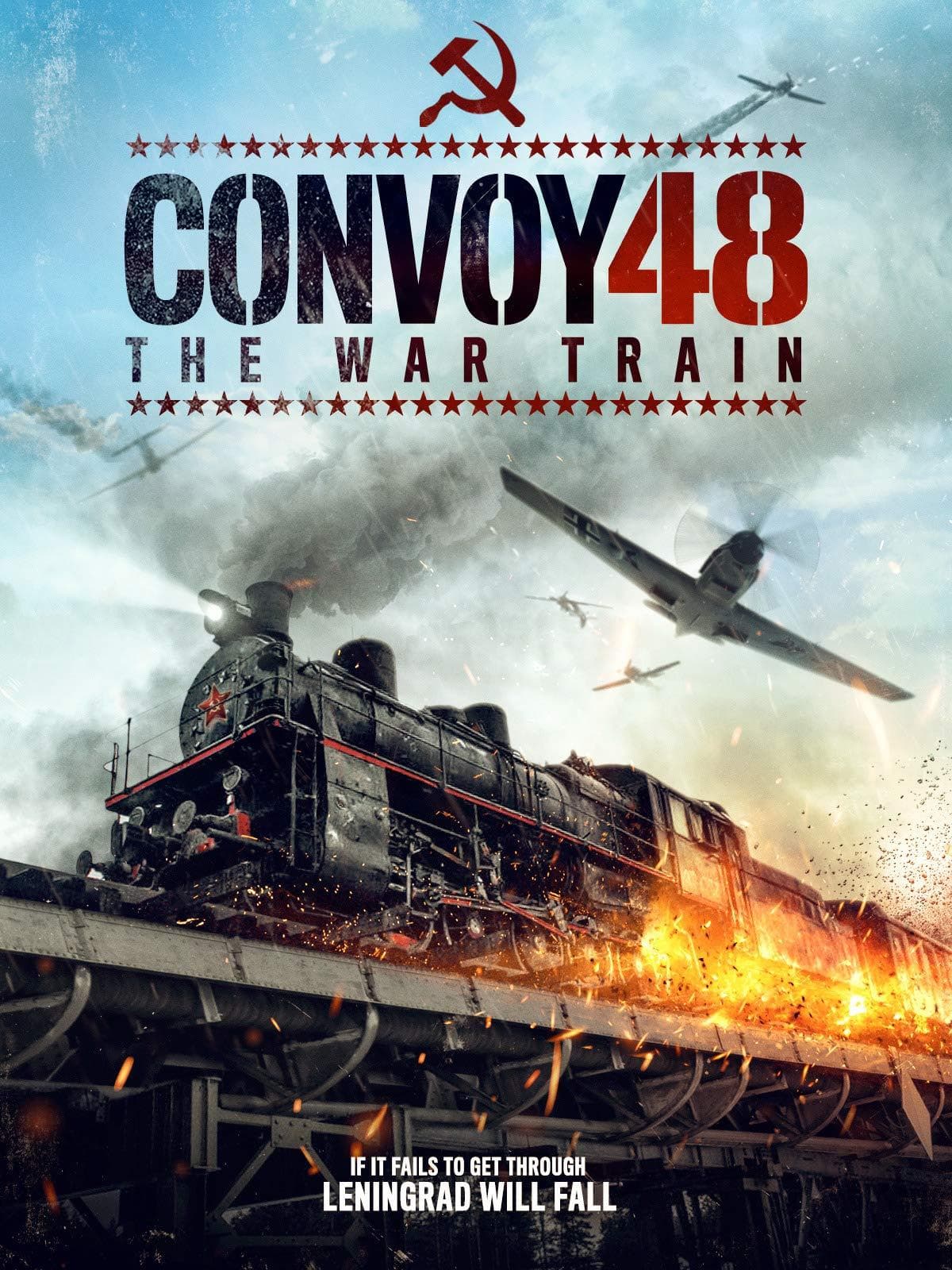
During the defense of Leningrad in the winter of 1941-1942, several women are tasked with delivering cargo and military equipment via the railways, facing German interference at every turn.
2h 20m available with multiple audio tracks and subtitles.

Fedor Popov
Director

Javier Calvo
Rodriguez

Tatyana Lyalina
Zoya Lipochkina

Veronika Turashvili
Kid on the train

Dmitriy Karalis
Writer

Fedor Popov
Writer

K ᗩ ᖇ ᗩ ᗰ 🥶
Jul 24, 2025This is a very long film. It really dragged in some places, but maybe that's because I'm not Russian, and so maybe I didn't get into the story as much as I would have. In my defense, I missed many of the subtitles because they went by very quickly, so I had to rewind many times and pause several times, but more often, I didn't even bother. The effects were kind of lame. Whenever the Germans sent an artillery "barrage" it was only two shells at a time, and they weren't very explosive. Having said that, the acting was good, and the script wasn't stupid. It seems that Russian filmmakers are now tryin to produce good motion pictures. It had the requisite romance subplot that at Soviet/Russian films about the war have, of course. It seems like an important story, too. I didn't know that a railroad bridge to Leningrad was built across the from lake that the city is in. I knew Leningrad was on an island and that the Germans blockaded it, but I only knew that the Russians trucked in supplies across the frozen water to get food and medicine to the starving and sick residents of the city. All-in-all, I didn't regret watching it like I do most Soviet/Russian films.

Hamza
Jul 24, 2025Development of the russian atomic bomb, and as dellutional everything might feel and look in russian 2nd world warfare tactics, the build up of this film are just the same, secretesse by all means, and do all the opposite things that everyone wouldnt do. so if it hadnt been for the courage and human sacrifice done by the railworkers and partisan women that built and maintained the lifeline to leningrad on rails then history wouldve take another turn, at least for the russians. this film is made as a propagandistic heave to boost russian patriotism of today, and that every task and deeds that were done in the great war have made it possible to be a proud russian even today. and these sequences are hard to swallow for a ola nordmann who lives in a multyparty democratic system that doesnt feed the guns with human bravery and shown through history, with lies to save the -''ism's'', and damages a rather special story and well made film. because the technical production are superb, some weak grenade hits and booms but for the rest pretty intense and seeworthy. because this film shows human sacrification at its best, and actors that do work at the shoots, and its very well drafted and acted even on a western standard. so if you wanna see a russian wardrama with some punch of helplessness and doomed to loose the battle then watch convoi 48, the grumpy old man did and recommends

Lando Norris
Jul 24, 2025Fascinating film about a micro-story of war within the context of the Battle of Leningrad. The film is masterful in all its parts, with well-constructed characters and highly believable actors. The narrative construction and scene sequences are built with an exceptionally high cinematic level, maintaining narrative tension from the first frame to the last. The viewer is transported to a perfectly recreated setting, enabling them to experience the tension, drama, and distressing sensations of the wartime experiences that many young Russians and women had to endure, employed in combat, logistics, and various service roles. Noteworthy is the work of the young and courageous Russian women who went above and beyond their stereotyped feminine roles of the era - and unfortunately even today - to contribute with their efforts and lives to the resistance against the Nazi oppressor. This film is another example of contemporary Russian production, adding to the extensive showcase of Russia's cinematic capability, which has nothing to envy in comparison to the best Hollywood productions in the war genre, often filled with biased perspectives and invented heroes. In this film, heroes are defined by their collective small acts rather than the grandiosity of constructing a cinematic superman who can do anything.

Arun Jain
Jul 24, 2025The Siege of Leningrad, also known in Russia as the Leningrad Blockade was part of Operation Barbarossa, the invasion of the Soviet Union by Nazi Germany. The forces deployed against the city included the Wehrmacht's Army Group North, Finnish and Italian troops and smaller contingents from other fascist countries like Spain. The siege lasted from September 1941 to January 1944. The objective was to fulfill Hitler's very explicit directive: to exterminate the entire population of Leningrad and raze the city to the ground. That failed, but nearly 1.5 million Soviet civilians and soldiers died, the former from bombing and shelling but mostly from starvation and sickness. To keep the city alive supplies were desperately needed. A road was opened between Leningrad and Lake Ladoga that continued across the lake. Watercraft were used in summer; in winter, they were replaced by trucks and a railway laid over the frozen lake. To operate the railway was hair raising dangerous; besides the ever present peril of the ice cracking, the trains were under constant artillery and aerial attacks. The road was known as the Corridor of Life or Corridor of Immortality, the Russian title of this film. I liked very much the fist hour and a half; there are many genuinely moving scenes. Near the ending, it goes a little Hollywood and quality diminishes. Also, it is too long. Nevertheless, it is worth watching. First rate special effects, excellent acting and fluid, dynamic direction.