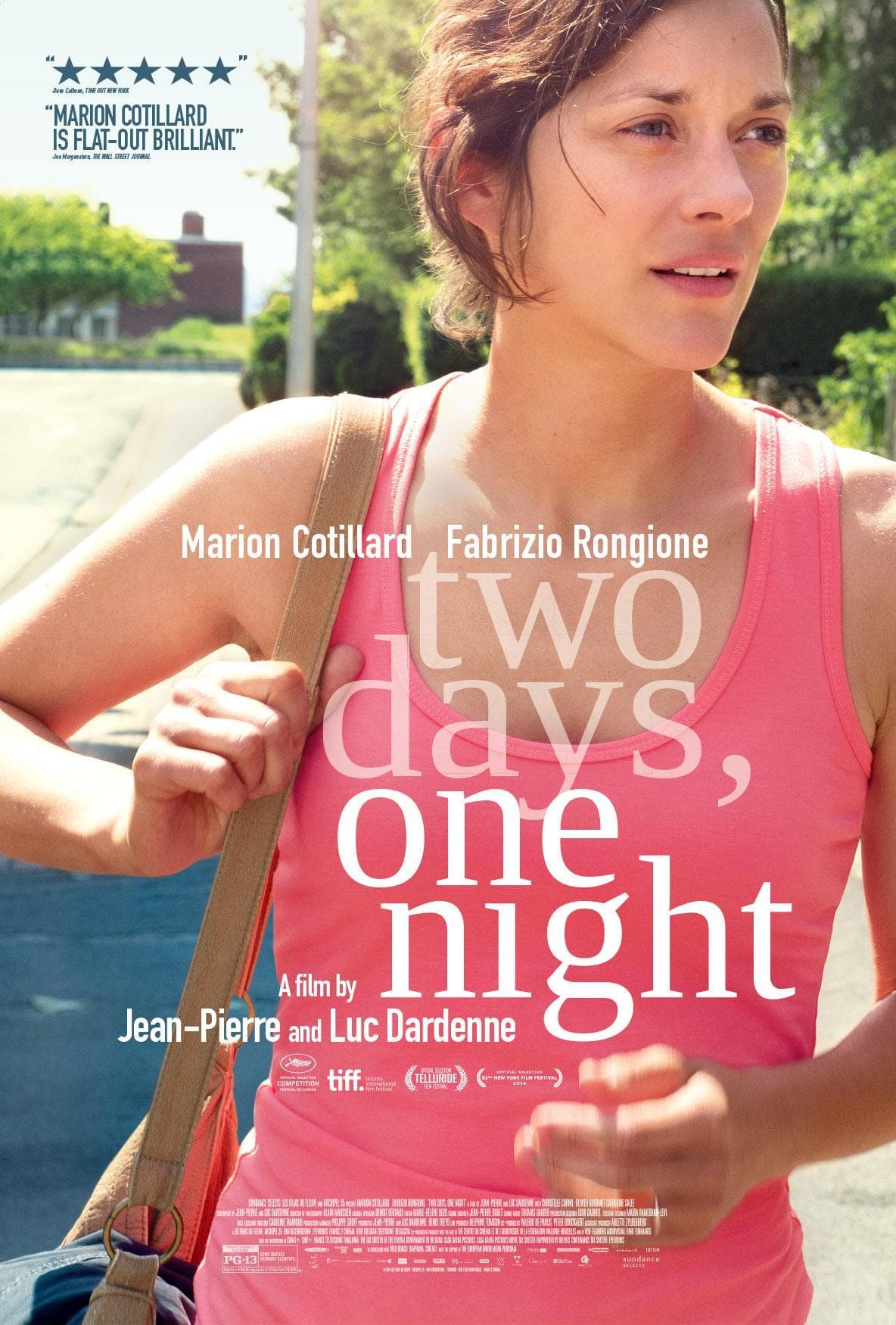
Liège, Belgium. Sandra is a factory worker who discovers that her workmates have opted for a EUR1,000 bonus in exchange for her dismissal. She has only a weekend to convince her colleagues to give up their bonuses in order to keep her job.
1h 35m available with multiple audio tracks and subtitles.

Jean-Pierre Dardenne
Director

Luc Dardenne
Director

Marion Cotillard
Sandra

Fabrizio Rongione
Manu

Catherine Salée
Juliette

Baptiste Sornin
M. Dumont

Pili Groyne
Estelle

Simon Caudry
Maxime

Moyu
Jul 24, 2025I have seen all the Dardenne brothers' movies, from La Promesse to this. I think that as they move away from lesser actors to well known ones, their movies are losing a bit of their bite. Cecile de France was half way believable as a hairdresser, but IMO, Marion Cotillard was simply not believable as a working class, down on her luck, factory worker. Marion to me, still seemed far too beautiful and glamorous for someone in that position. I could believe she was depressed and anxious, but working class, no. They should have dressed her in far uglier clothes, had her hair frizzy and badly cut (not just tied back in a pony tail) and had her wear absolutely no makeup. We saw a far bigger transformation of her appearance in Rust and Bone than in this movie. Then there was the story. Really, though it hung together (unlike Lorna's Silence) I found it rather repetitive and monotonous. Each time she approaches a colleague with the same story and they will say yes or no. The section where she takes a bottle of Xanax was totally unrealistic. Even if she were able to vomit up most of the tablets, she would be groggy and not ready to continue her campaign. Nor would a reputable hospital let her, IMO. This was a suicide attempt and I'm pretty sure she would have been made to stay at least a few days under observation, if not in their psychiatric ward, then just to make sure all the drugs were out of her system. I thought the film was very well shot and that the performances other than Ms. Cotillard's were quite good. That is why I have given the movie a 7 and not a lower number.

Puseletso Mokhant'so
Jul 24, 2025The storyline of this film is a bit like the Sidney Lumet classic '12 Angry Men'. One person needs to convince a group of others. In '12 Angry Men', Henry Fonda convinced his fellow jurors that the accused must be innocent. In 'Deux Jours, Une Nuit', factory worker Sandra tries to convince her fellow workers to give up their bonuses, so she won't be fired. Their employer doesn't have enough money to pay Sandra and the bonuses, so he lets the staff decide what they want. But whereas Henry Fonda persuaded the jurors with arguments, Sandra tries to do it with emotion. 'I want to stay with you', she tells her colleagues, 'and not become unemployed and alone'. The film follows Sandra during the weekend preceding the vote, planned for the next Monday morning. We see her going from door tot door, ringing every bell and asking her colleagues literally the same question: can you vote for me, so I can stay? The reactions vary. Some say they are sorry, but they need the money. Others promise to talk about it with their husbands. Some promise their support immediately. One turns to violence. The Dardenne brothers, who directed this film, usually work with little-known actors. This time, they chose a big star for the lead: Marillon Cotillard, who worked with directors like Christopher Nolan on big budget productions. For the film, it doesn't make much difference. Cotillard totally immersed herself in the Dardenne-method (she calls it her 'Dardennisation'). The camera follows her closely during her weekend-long quest, and shows her as a vulnerable woman, who constantly seems to be on the verge of a nervous breakdown, repeatedly starts crying and constantly doubts her own capabilities. The Dardenne brothers are famous for their own film making style, which consists of very intense scenes, filmed without any glamour, showing the raw reality of working class life in their own city, the Belgian industrial centre Liège. This style worked very well in some of their films, notably the unemployment drama 'Rosetta' and the coming of age-film 'Le fils'. I think in 'Deux Jours, Une Nuit', it works not so well. After a while, the door-ringing starts to get a bit tedious, partly because Sandra asks exactly the same question every time, and partly because the reactions of her co-workers are mostly rather predictable. The plot could have been worked out better this time: it offers lots of possibilities the Dardennes haven't used. This is probably a deliberate choice: the plot is never the strong point in their films because they focus on the emotions of their characters. What drives the movie forward, is the suspense: will she get enough voters to keep her job, or will all her efforts turn out to be futile? After such a build-up, you expect something special: not a simple yes or no. I will not give any spoilers, but I was a bit disappointed, also by the almost emotionless way Sandra handles the outcome. 'Deux Jours, Une Nuit', is a good film, showing the raw reality of an economic downturn. But in my opinion, the Dardennes have made better films.
ሀበሻን MeMe
Jul 24, 2025If you are curious to check this movie out and see what all the fuss at Cannes and of the critics is about, just like me, I would recommend you to save the money. "Two days, One Night" is a more than decent film, but nothing else. The problem is the fact that it thinks too highly of itself. Why do I say that? Many critics have praised the movie for its honesty, the pureness of its message and the delicacy. Well I really disagree. There certainly is an extent of honesty in the staging of the family everyday life, but with all its intrusive long takes, its high number of aimless long scenes, some key dialogue lines that feel out of nowhere, a couple too many cringe moments and, most importantly, its disappointing ending, I found the film to be much more manipulative and convenient, than honest. The ending did not make a point to me and was a total 180 from where the whole movie was going, it felt very convenient and in no way ended the movie, There had to be ten minutes more or ten minutes less for it to stamp something. That is not to say that there aren't many thinks to like. Marion Cotilliard, first and foremost alongside the widely interesting look at humanity, offered by the movie. This isn't your general black and white statement offered-in-the-last-five-minutes type of reflection, under which many dramas fall. This is a profound analysis of what does it mean to be thrust into an impossible situation and how would each of us deal with it if put in the same place. This combined with the premise of the movie is enough to keep the 95 minutes going fluently without ever boring things down, but never during the movie did I feel profound emotional connection with any of the characters. I wanted it to be slightly more nastier and dramatic.

lekshmipalottu
Jul 24, 2025In the film Two Days, One Night (or Deux Jours, Une Nuit for those of you who parle vu frances) academy award winning actress Marion Cotillard plays solar panel factory worker Sandra. Sandra has returned from a long work hiatus for depression, only to find out that her job has been eliminated. Sandra's co-workers all took a vote in order to keep their bonus, they had to eliminate her position. Sandra's friend manages to get the vote to be redone. So Sandra and her husband Manu have two days to go confront each of her co-workers and convince them to forego their bonuses so that she may stay employed. I think this film loses a little in translation and understanding of cultural norms. This is a Belgian film, entirely in French with the exception of one moment where the characters enjoy Gloria by Van Morrison that they sing together. I guess I am going to have to claim my American ignorance here. There are a lot of things I am not getting as far as cultural differences. Here is a small list: 1.) Is having co-workers vote on others terminations as a means for financial benefit a common occurrence in the rest of the world. Seems kind of cruel and less than fair. Plus to have someone come try and make me feel bad about my decision by confronting me, seems very uncomfortable. 2.) Are Belgian men really that sensitive? I saw a lot of dude tears for no reason in this film. 3.) Is everyone in Europe as formal as it shows in this film? Every conversation must start with a hello and end with a goodbye. They never missed on that one. Culturally I found it noteworthy. 4.) Sandra gets a long time of PAID time off for depression, plus she is a drug addict. I had a very hard time scraping together enough empathy for her character to get me through this movie. Plus every person she confronted seemed to be working at least one other job. Sandra barely could accomplish the job of begging for her job back. She should have just cut her losses and got another job. All the people she talked to needed that money and as far as I was concerned she was not that great of an employee to begin with. Marion Cotillard is nominated for her performance in this film. I think she was very convincing a depressed woman, but I failed to see the great in this performance. But I don't watch a lot of foreign films. I can count on one hand the amount of foreign films I have seen and enjoyed, Amelie (2001), Cinema Paradiso (1988) and Does the Godfather II (1974) count since the DeNiro Scenes are all in Italian? So I will admit I am not as cultured as seeing this film would require. So I am for sure not the demographic for this movie. That being said I would pass on this film. No violence, no nudity, no laughs, no fun. Not a lot of action to speak of, just a sad woman going door to door begging. The end, which I will not spoil, is kind of a tie in to a greater good of humanity message, but the payoff is not worth the journey.